

Cyprus Business & Tax
Why 18,858 Companies Were Registered in Cyprus Last Year (Up 26.5%)
Numbers don't move like this by accident. In 2025, 18,858 new companies were registered in Cyprus, up 26.5% from 14,908 the year before, according to the Cyprus Registrar of Companies. That's not an anomaly. It's a signal. See also: how AI can help a new Cyprus business.
These are international founders, C-suite executives, holding company structures, and tech businesses making a deliberate choice. They're choosing Cyprus over other EU jurisdictions. The question worth asking is: why?. See also: which tasks to automate first when starting out.
This piece walks through the real reasons: tax, speed, location, and infrastructure. No sales pitch. If you're evaluating where to incorporate your next company, here's what the data actually tells you.
The Numbers: What 26.5% Growth in One Year Actually Means
18,858 companies in a single year is a meaningful figure for a jurisdiction with a population of just over one million. Cyprus is registering roughly 52 new companies every day.
The 26.5% year-on-year growth indicates that demand is accelerating, not plateauing. As reported in the Cyprus Mail, Cyprus has historically attracted offshore structures and holding companies, but the 2025 surge reflects a broader trend: founders and operators are choosing Cyprus as an actual operational base, not just a tax address.
Several factors converged to make 2025 particularly strong: the finalisation of the tax reform gave clarity to founders who had been waiting to see the post-reform picture; the continued digitalisation of the incorporation process removed friction; and growing awareness among Israeli, German, Polish, and broader European founder communities confirmed that Cyprus had materially improved its offering.
Tax That Still Competes: 15% Corporate Rate, 0% Dividend Gains, IP Box Intact

The Cyprus corporate income tax rate increased from 12.5% to 15% on 1 January 2026, aligning with the OECD Pillar Two minimum tax framework. This was the most-watched change in the reform. For most businesses evaluating Cyprus, the conclusion is clear: it remains one of the lowest corporate tax rates in the EU, and the broader package is still highly competitive.
The full reform picture, from Dixcart Cyprus, is worth reading in detail. The headline changes that matter most:
0% on dividends and capital gains. Dividend income and capital gains from the disposal of shares remain untaxed. For holding companies and investment structures, this is the number that matters most.
IP Box regime intact. Companies with qualifying intellectual property pay an effective rate of 2.5% on IP income. One of the most competitive IP regimes in Europe, unchanged by the reform.
R&D super-deduction extended. The 120% super-deduction on qualifying research and development expenditure has been retained and extended, which is meaningful for tech companies spending on product development.
Stamp duty abolished. Stamp duty on most transactions has been removed, reducing transaction costs.
Special Defence Contribution reduced. The SDC on dividend distributions to ordinary tax residents drops from 17% to 5%. A significant improvement for operating companies distributing profits to shareholders.
Double-tax treaty network. Cyprus maintains treaties with over 60 countries, including Israel, Germany, the United States, India, and the UAE. For businesses with cross-border income, this is a material operational advantage.
The post-reform picture: a 15% headline rate that remains competitive in EU context, with the holding and investment structure advantages largely intact.
How Fast Is Fast? The Cyprus Incorporation Process Step by Step
Speed of incorporation is a practical concern that separates jurisdictions on the margin. Cyprus has invested significantly in digitising the process.
The result: in most cases, a company can be registered in Cyprus in 7 to 14 business days, assuming documentation is prepared in advance. The process is fully digital, and no physical presence in Cyprus is required for incorporation.
The typical steps:
1. Name reservation. Proposed company name submitted for approval, typically 1 to 2 days.
2. Document preparation. Memorandum and Articles of Association, director and shareholder details, registered office address in Cyprus (a Cyprus-registered office is mandatory).
3. Submission to the Registrar. Filed electronically via the online portal.
4. Certificate of incorporation. Issued within 7 to 14 business days from submission.
5. Post-incorporation. Tax registration (TIC number), VAT registration if applicable, bank account opening.
The bank account step deserves a separate note. Cyprus banks have tightened compliance requirements significantly over the past decade. Expect a thorough due diligence process covering source of funds, business activity, and beneficial ownership documentation. Budget 4 to 8 weeks for banking to become operational after incorporation. This is standard across serious EU banking jurisdictions. It is not a Cyprus-specific problem, but it is worth planning for.
Strategic Location: Why Cyprus Works as an EU Hub for EMEA Operations
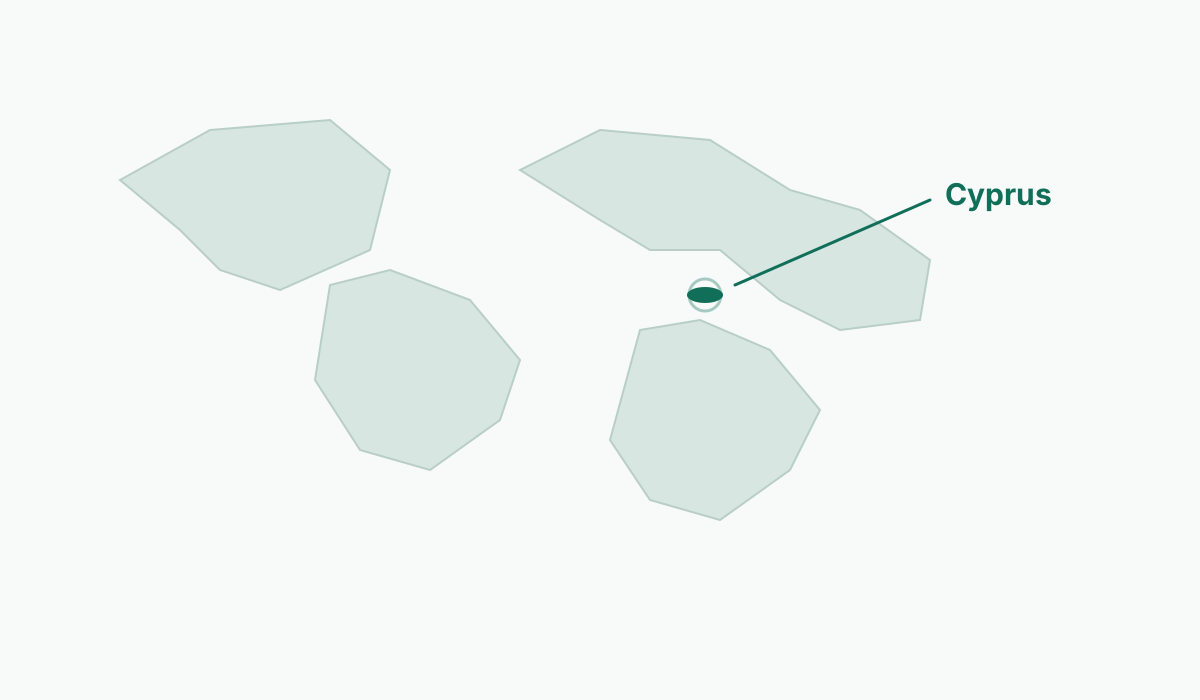
Cyprus sits at the intersection of three continents: Europe, the Middle East, and Africa. For companies whose client base, supply chains, or investor networks span these regions, that geographic position is a genuine operational advantage.
For companies operating between the EU and Israel, Cyprus is the most natural home. The legal system (based on English common law), the double-tax treaty with Israel, and the established Israeli business community in Limassol make it the default choice for Israeli founders accessing EU markets. Invest Cyprus documents the full range of sectors and incentives for inbound investors.
For companies operating between Europe and the Gulf (Saudi Arabia, UAE, Qatar), Cyprus offers EU regulatory credibility combined with cultural proximity to the Middle East that most Northern European jurisdictions cannot match.
Cyprus is also a full EU member state. That means access to EU markets, SEPA payments, EU banking infrastructure, and the regulatory framework that global counterparties, investors, and customers recognise. For a company selling into Europe or raising from European investors, Cyprus passporting is a practical asset.
Beyond Tax: Banking, Infrastructure and the Growing Talent Pool
Tax is the reason most founders start their Cyprus evaluation. It is rarely the only reason they stay.
Banking. Cyprus operates within the EU banking system with access to SEPA and Swift. The major banks (Bank of Cyprus and Eurobank Cyprus) are well-capitalised and EU-regulated.
English. Cyprus operates on English common law. English is the primary language across professional and business services. For non-Greek-speaking founders, this removes a significant operational friction that affects incorporation in France, Germany, or Spain.
Quality of life and founder community. Limassol has developed into a genuine international business hub. A growing community of founders, investors, and operators from Israel, Ukraine, Germany, and across Europe has established itself there. The infrastructure has followed: international schools, direct flights to major European cities, co-working spaces, and a property market that reflects sustained demand.
Macroeconomic stability. Cyprus currently has the lowest inflation rate in Europe. In a period when operating costs are rising across much of the continent, this is a meaningful differentiator for businesses with significant Cyprus-based headcount or operations.
ZingZee is itself a Cyprus-based AI company, built here in Limassol and operating internationally. The business case for Cyprus isn't theoretical from our perspective.
Is Cyprus Right for Your Business? A Quick Checklist
Cyprus works particularly well for:
Holding companies. 0% on dividends and capital gains from shares, extensive double-tax treaties, low corporate rate, minimal bureaucracy after incorporation.
Tech companies. IP Box at 2.5% effective rate on qualifying IP income, R&D super-deduction, strong English-speaking developer community, growing tech ecosystem.
Finance and investment structures. EU-regulated environment, passporting, established professional services (law, audit, fund administration).
Professional services firms. Low operating costs relative to Western Europe, English-language infrastructure, access to EU and Middle East client bases.
Hospitality businesses. Particularly those operating in Cyprus or the Eastern Mediterranean, benefiting from being incorporated in the jurisdiction where their assets are located.
Cyprus is a less obvious fit if you need a major financial centre with deep capital markets (Frankfurt, Amsterdam, London), a large domestic consumer market, or a specific regulatory regime not yet established in Cyprus.
For most international founders evaluating an EU base with competitive tax, fast incorporation, EMEA reach, and English-language infrastructure, Cyprus clears the bar comfortably. The 18,858 companies registered in 2025 are the data point that confirms it.
Conclusion
18,858 companies. Up 26.5% in a single year. That kind of growth doesn't happen because of one incentive or one good news story. It happens when a jurisdiction gets the fundamentals right across tax, speed, location, and infrastructure, and enough founders figure that out at the same time.
Cyprus has been building toward this moment for over a decade. The 2026 tax reform confirmed rather than disrupted what the jurisdiction has to offer.
If you're evaluating where to incorporate your next company, the data is pointing clearly.
If you're setting up in Cyprus or already operating here, ZingZee can help you build the automated back office that lets a lean team punch well above its weight. Get in touch.
Thinking about running your Cyprus business more efficiently? ZingZee builds AI employees that handle enquiries, follow-ups and admin, 24/7. Book a free audit to find out what can be automated: https://www.zingzee.com/contact
Frequently Asked Questions
Is Cyprus still a good place to register a company in 2026 after the tax reform?
Yes. The corporate tax rate increased from 12.5% to 15% from 1 January 2026, but Cyprus remains one of the lowest-rate EU jurisdictions. More importantly, the advantages that make Cyprus attractive for holding and investment structures (0% on dividends and capital gains, the IP Box regime, the R&D super-deduction, and the double-tax treaty network) are all unchanged by the reform.
What is the Cyprus corporate tax rate in 2026?
15%, effective from 1 January 2026, aligned with the OECD Pillar Two minimum tax framework. Special regimes apply: qualifying IP income is taxed at an effective rate of 2.5% under the IP Box regime, and dividend income and capital gains from share disposals remain at 0%. The Special Defence Contribution on dividends has also been reduced from 17% to 5%.
How long does it take to register a company in Cyprus?
Most companies are incorporated within 7 to 14 business days from submission, assuming documentation is complete. The process is fully digital. No physical presence in Cyprus is required for incorporation. Bank account opening typically takes an additional 4 to 8 weeks due to compliance and due diligence requirements.
What types of businesses benefit most from Cyprus incorporation?
Holding companies, tech companies with qualifying intellectual property, investment and finance structures, and professional services firms with EMEA-facing operations benefit most. The combination of 0% on dividends and gains, the IP Box, the R&D super-deduction, and the double-tax treaty network makes Cyprus particularly effective for businesses with cross-border income streams.
Do I need to be a Cyprus resident to register a company there?
No. Non-residents can incorporate and act as shareholders or directors of Cyprus companies. However, for tax residency purposes, having a Cyprus-resident director (or a majority of directors resident in Cyprus) is generally recommended to establish management and control in Cyprus for treaty purposes. A Cyprus-registered office address is mandatory.